A Conversation With Chandra: Advice to a young scientist : Amitabha Sen
Sen:
Do you plan to start a new project after your book on black holes is completed?
Chandra:
The last time I undertook a major project was in 1974, six years ago. I had completed work with John Friedman and had written several papers with him. Then I decided to work on black holes. Now, at the age of 70, it is difficult to make plans for the next seven years. It is like whistling in the dark. I am not ambitious anymore. I was when I was younger.
Sen:
Could you perhaps write about your philosophy of science? You have witnessed major changes in physics in your lifetime. It might be useful for people to know your views.
Chandra:
I cannot really take myself seriously on these matters. Do you know Kamesh Wali? He has started writing my biography. He comes here often and has visited and talked to many people who know me, my past students, etc. I don’t know why he is wasting his time on me. I understand he is a good physicist and could profitably be doing research than this .
Sen:
It is important to know, for example, your views on nature. How has it evolved over the years? How do you view science?
Chandra:
Well, the only part of me that might be of interest to anyone is my attitude towards science. There are very few people I know who have done work as consistently, with the same vigor and standard, as I have. My work is at least to some degree nontrivial; otherwise why would my books still be in print if they were not of any use? Hawking & Ellis refer to work I did in 1930 and also in 1972, which goes to show that my contribution is at least to some extent nontrivial. It might be of interest, to some people, to know why I could do this, what was my motivation.
My attitude can be summarized by my reaction to the following question: Murray Gell-Mann once asked, "What has Freeman Dyson done?" I regard this remark as obscene. He (Gell-Mann) has discovered [see Note 6] the Eightfold Way, quarks, Omega-minus and what not, but that does not qualify Dyson as being inferior. To me Dyson is far above Murray.
Sen:
You must then have some criteria for making this judgment.
Chandra:
Yes. Peter Freund also had said in some other context the same thing:
“What has Dyson done?” I told him: “Dyson has read Paradise Lost nine times before the age of nine. Have you done that?”
To me, the purpose or rather the attitude one should have in life is to sharpen one’s sensibilities. Reading Paradise Lost is one. In science, one should try to understand whatever little one can comprehend so that one understands things to one’s own satisfaction. But most important is the fact that one should realize one’s limitations and work within the bounds of one’s limitations. It is pointless for me to say I am going to be at the level of Einstein. Some people indeed do this. From the remarks he has made, it seems Feynman is one such.
Sen:
I thought discoveries were made by stumbling upon them, not by saying I'm going to make a great discovery.
Chandra:
Actually there are many people who have done it that way. Why, Watson in his book (The Double Helix) wrote that he had always wanted to win a Nobel Prize and went and did it.
Raman was like that too. Let me tell you a couple of stories about Raman. I don’t know if I’ve told them to you before. Raman was invited to Toronto to deliver some talk, and while he was there Millikan invited him to Caltech as a visiting lecturer. Nothing great about it. Raman thought he was well known in the world (this was before his Nobel Prize). At Caltech he taught a course in thermodynamics and there were only two students in his class. He was very depressed by this, for he thought he would get a very large audience. Rosseland, who had worked with Niels Bohr and later moved to astrophysics, was one of the two who attended the lectures. He told me years later that every evening Raman would visit him at his home very depressed by the fact that he was not getting any attention there, and each evening, as he left, he would say: “I will go back to India and make a great discovery and then everyone will know me." Rosseland thought Raman was some kind of a charlatan, but years later he told me, "By god, he did it!”
In 1961, when I was visiting India, I went to meet Raman. Coincidentally, he had just received my book on magnetohydrodynamics. As I entered his office, he said "How do you get time to write these books? I never could get any time to write books. Once I thought I would write a book on optical resonance but someone else was writing it and so I continued with my research and got the Nobel Prize.” Hearing this, my response was: “My god, I have lost four Nobel prizes!” Anyway, there are such people.
Raman died at the age of 82, in 1970. During the entire forty or so years after he won the Nobel Prize there was not one occasion when he wouldn’t let you know that he had won the prize. During his later years he worked on the physiology of vision and wrote a book. He gave me a copy and said, “You must know eminent physiologists in the US. Show them this book. I’m sure it deserves a Nobel Prize.“
Whenever I talk about my attitude in science this quote springs to mind.
"There is a square; there is an oblong," begins a passage from Virginia Woolf’s The Waves. "The players take the square and place it upon the oblong. They place it very accurately; they make a perfect dwelling-place. Very little is left outside. The structure is now visible; what is inchoate is here stated; we are not so various or so mean; we have made oblongs and stood them upon squares. This is our triumph; this is our consolation."
Lest you think Raman was a singular case, let me tell you about Harold Urey (after his Nobel Prize). At that time I used to drive down to Chicago from Yerkes on Thursday mornings to deliver lectures, one in the morning, one in the afternoon and one the next day, Friday. I returned to Yerkes late in the evening on Fridays. Every Thursday morning at nine o’clock, a blue Buick would stand on University Avenue and everyone knew I was on campus. When I came into my office, people would be waiting for me. Well, one morning, I came in, went to the Club to have a cup of coffee and found a message that Urey wanted to see me. I then went to the press to do my editorial work for the Astrophysical Journal and the secretary told me that Urey wanted to see me. I went to take my class at 9 am and the physics department secretary walked in to say Urey wanted to see me. Evidently he was anxious to see me. So after the class I went to see Urey instead of going to lunch. He said, "Well it's not very important. Tell me Chandra, am I going down the deep end?" (At that time he was working on some problem related to the moon.) Now, obviously, anyone of Urey’s eminence who asks this question of someone fifteen years or so younger to him is not a very happy man.
Sen:
I believe David Hilbert also had similar doubts late in life.
Chandra:
Yes. But I feel I am happy with what I have accomplished. It is not important what others may have said. Throughout my work I've been satisfied. No one can take this away from me. I happened to be in elite company - Dirac and others - which has a sobering influence on your ambitions. But there are people like these. I don't think there is any moral to these stories. They may not be of any interest.
=========================================================
Notes:
1. This conversation took place on March 16, 1980 (before Chandra’s Nobel Prize) in the Relativity Group, Enrico Fermi Institute, The University of Chicago.
2. A guide to the Subrahmanyan Chandrasekhar Papers, 1913-2011, can be found here: https://www.lib.uchicago.edu/e/scrc/findingaids/view.php?eadid=ICU.SPCL.CHANDRASEKHAR
3. People mentioned in the article:
• Chandrasekhar, Subrahmanyan (1910-1995), Nobel Prize in Physics 1983
• Bohr, Niels (1885-1965), Nobel Prize in Physics 1922
• Dirac, Paul A.M. (1902-1984), Nobel Prize in Physics 1933
• Dyson, Freeman J. (1923-2020), Theoretical physicist, The Institute for Advanced Study, Princeton
• Einstein, Albert (1879-1955), Nobel Prize in Physics 1921
• Feynman, Richard P. (1918-1988), Nobel Prize in Physics 1965
• Freund, Peter G. O. (1936-2018) Particle physicist, The University of Chicago
• Friedman, John L., Gravitational physicist, University of Wisconsin-Milwaukee, Ph.D student of Chandra
• Gell-Mann, Murray (1929-2019), Nobel Prize in Physics 1969
• Hilbert, David (1862-1943), Mathematician, Göttingen University
• Millikan, Robert A. (1868-1953), Nobel Prize in Physics 1923
• Raman, C.V. (1888-1970), Nobel Prize in Physics 1930
• Rosseland, Svein (1894-1985), Astrophysicist, University of Oslo
• Urey, Harold C. (1893-1981), Nobel Prize in Chemistry 1934
• Watson, James (1928-2025), Nobel Prize in Physiology or Medicine 1962
• Wali, Kameshwar C. (1927-2022), Particle physicist, Syracuse University
5. Books mentioned in this article:
• Chandra: A Biography of S. Chandrasekhar, by Kameshwar C. Wali, The University of Chicago Press, 1990.
• The Mathematical Theory of Black Holes, by S. Chandrasekhar, Oxford University Press, 1983.
• Hydrodynamic and Hydromagnetic Stability, by S. Chandrasekhar, Oxford University Press, 1961.
• The Large Scale Structure of Space-time, by Stephen Hawking and George Ellis, Cambridge University Press, 1973.
• The Double Helix, by James Watson, Atheneum Press, 1968.
6. In the early 1960s, a well known subject in mathematics, called group theory, seemed ready-made for classifying particles. One group, called SU(3), was proposed independently by Professors Gell-Mann at California Institute of Technology and Yuval Ne'eman at Imperial College, London. This classification of particles was named by Gell-Mann The Eightfold Way. A prediction of this theory was a particle called Omega-minus which was discovered in 1964.
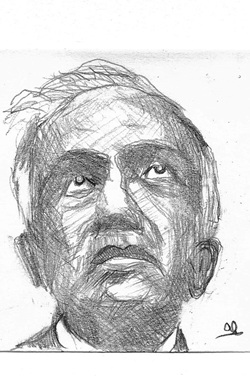
অলংকরণ (Artwork) : Amitabha Sen