-
পরবাস
বাংলা ভাষা, সাহিত্য ও সংস্কৃতি
Parabaas, a Bengali webzine since 1997 ... ISSN 1563-8685 -
ছোটদের পরবাস
Satyajit Ray
Rabindranath Tagore
Buddhadeva Bose
Jibanananda Das
Shakti Chattopadhyay
সাক্ষাৎকার -
English
Written in English
Book Reviews
Memoirs
Essays
Translated into English
Stories
Poems
Essays
Memoirs
Novels
Drama

The Land Where
I Found It All-

Order Here for Free Shipping in India
-

পুত্রবধূর কলমে গৌরী আইয়ুব এবং প্রসঙ্গত
-

বিশ্বের ইতিহাসে হুগলি নদী
-

বেদখল ও অন্যান্য গল্প
-

Audiobook
Looking For An Address
Nabaneeta Dev Sen
Available on Amazon, Spotify, Google Play, Apple Books and other platforms.
-

পরবাস গল্প সংকলন-
নির্বাচন ও সম্পাদনা:
সিদ্ধার্থ মুখোপাধ্যায়)
-

Parabaas : পরবাস : বাংলা ভাষা, সাহিত্য ও সংস্কৃতি -
পরবাস | English | Novel
Share -
Dreams and Other Blues (5) : Abhijit Sen
translated from Bengali to English by Chhanda Chattopadhyay Bewtra
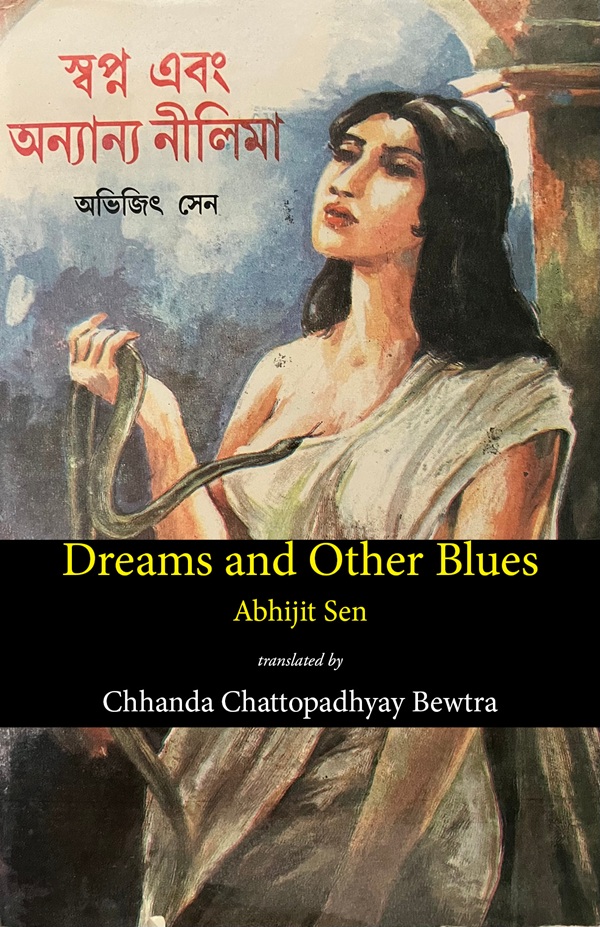 Abhijit Sen's novel স্বপ্ন এবং অন্যান্য নীলিমা (Dreams and Other Blues) first appeared about 28 years ago in a special issue of Pratikshan. After considerable revision, it was published as a book in 2000 by Dey's Publishing, Calcutta.
12.Three separate events took place at the same time. One happened right in front, the second not quite that close but still at a visible distance, and the last one took place about 500 kilometers away but was still directly connected to Saroj.
There was nothing outwardly similar in these events, but some hidden relationship existed. All three were historical and connected to each other with invisible ties.
The first event occurred in front of his eyes. As on every day, he had reached the refugee camp at nine in the morning and found the grey jeep, with 300,000 kilometers on it, waiting in front. An Indian army soldier waited next to it, and at the steering wheel sat the same person from the Muktibahini.
Saroj looked around but could not find the Mukti man who had looked like Che. For some reason, he wanted another look at him. He had a truly heroic appearance and reminded Saroj of his own passion and fury from earlier days. He knew those days would never return.
Saroj had asked around and found out that his name was Zulfiqar. He was the commander of a guerrilla unit. Their job was to harass the Pakistani troops along the border zones of Jaypurhat—Damuirhat—Sapahar and Porsa areas. Their base camp was a border outpost named Jalghar, about four miles from the city. Many such units worked under the captains from the Indian Army, which also provided their arms and other supplies. Once a target was designated, the Muktis took shelter in nearby hide-outs. Then, at an opportune time, they sniped at a stray Pakistani unit or harassed them in other ways, including sabotage. Zulfiqar was the commander of such a group.
Before Saroj even reached his office, he sensed a suppressed excitement spreading like a mist throughout the camp. His office was the last room on the right side of the ground floor of the upside down 'U' shaped schoolhouse building. A wide verandah surrounded the building like the border of a sari. The second floor also followed the same plan.
As Saroj climbed the verandah in front of his office, he saw a stir in the group gathered on the second floor. Zulfiqar’s rifle was pointing at a lungi-clad, bare-chested man. There were two other armed men on either side; one was Zulfiqar’s companion from the previous day, and the other was an Indian soldier, in uniform. One woman was flailing herself at their feet, perhaps begging for mercy. Her cries were loud, but no words could be understood.
At any rate, the meaning of the dramatic scene was instantly clear to all. Zulfiqar’s victim was doubtless a Pakistani collaborator or somebody like that who, for some reason, had sought shelter in this camp. Zulfiqar’s group got the news and came to seek vengeance or prevent sabotage in the camp. Although not widespread, the Pakistani Army did attempt occasional sabotage or assassination. Ten days ago, they blew up a culvert by mining and hurt many people. They even kidnapped one villager recently and murdered him.
Saroj waited outside his office. After a while, the group emerged downstairs. Again, the same scene.
They stepped off the verandah into the courtyard, occasionally hidden behind the barracks. By now, concerned men and women had been following them at a safe distance. The woman still pleaded for mercy. Now Saroj could understand her words.
“O brother Zulfiqar, I’m your sister--"
It meant they were known to each other.
“Please forgive him--”
The soldier angrily pushed the man away. The woman came running and threw herself again at their feet.
“Please don’t ruin us, brother. I have a child in my womb.”
Saroj saw indeed that her lower abdomen was swollen. Without thinking, he stepped in front of the soldiers and asked, "What’s going on? Where are you taking him?”
The prisoner suddenly launched himself to his feet. At last, he saw a faint ray of hope.
“Sir, please save me. Allah knows, I’ve done nothing wrong.”
The soldier hurriedly pulled him up, tugging his lungi. The fabric tore and almost made him naked. While the man somehow tried to cover himself, the soldier hit him on his unprotected face with his heavy Sten gun. His hits made clear that he was used to such attacks. The prisoner was still trying to cover himself as blood flooded his face and nose.
Without acknowledging Saroj’s presence, the soldier pointed his gun and stomped. “Hath jaao--move aside!”
In other words, they were not willing to talk or listen to anyone.
They beat the man and shoved him in the jeep. The woman thrashed about on the ground and wailed in desperation. She was rubbing her tearful face in the dust, perhaps self-flagellating for not being able to follow her husband to his killing ground. At last, a few women came to pick her up and take her away.
In this chaotic, busy town, ‘Jai Bangla’ was the main theme in the daily lives of the people. Jai Bangla was in the center of all trades, offices, courts, markets, and schools. Even political activities were centered around this.
Even then, one evening, around eight, a businessman was murdered in the marketplace.
The man was named Harimon Sha, that is, Harimohan Saha. He had a wholesale business of daily necessities. There was the usual rivalry with other traders. Still, his murderers spread Naxalite pamphlets and cried Naxal slogans as they fled.
The next night, in the early morning hours, police raided Atashi and Krishnapriya’s house. They searched all rooms with a fine-toothed comb while questioning them about their Naxal son’s whereabouts. The next day, the EFR police force searched all the suspicious areas in the town.
Harimohan’s own friends, however, pointed their fingers at some of their kinsmen. Everyone knew how Harimohan arbitrarily inflated the prices of certain goods, creating artificial scarcity. Harimohan and others like him had heard of the Naxalites but did not see any reason to fear them in this town. So, they took no precautions. Ordinary people are mostly so harmless and obedient to the rules that Harimohan and his friends saw no need for protection against them.
Whoever the murderer was, it precipitated a feud amongst the kinsmen. One day, Harimohan’s youngest son, Gobinda, slapped one of his uncles. That exacerbated the fighting. Complaints and counter-complaints were lodged at the police station. The fights between the uncles and nephews got so bad that they disrupted the supply and trade of essential items for the townspeople. Seeing an opportunity, rival businessman Brajadulal Sha obtained the government’s permission to use Harimohan’s license and permit to monopolize market supply.
Harimon Sha had grown his business through his own efforts. His brothers supported him and worked hard under his direction. After establishing a monopoly over lentils, oil, spices, sugar, and other essential goods, as Harimon expanded his business into clothing and hosiery, his brothers began to feel they were being deprived of their fair share. Whether someone appointed a Naxal as a hired gun or whether the murderers were Naxals at all was never clear and generated much speculation in town. The prices had come down following the murder, but started to go up again for no known apparent reason.
The third event, although farthest from them, affected Saroj the most. He had always carried a strong guilt that his family had to pay the price for his political activities. Stepping away from that life had brought him some solace. Getting a letter from his youngest sister in Calcutta again stirred up all the suppressed emotions. The special branch of the police had arrested Pranab. They came early in the morning and took him away without offering any reason. But a couple of weeks ago, three boys who had escaped from jail had sheltered in their house for a few days. His sister guessed that one of them had been re-arrested and spilled the beans about them. She warned Saroj not to suddenly appear in Calcutta. She also informed him that their father was very ill and needed medical care.
13.
Bikash’s new play was attracting a good audience. The refugees were eager to enjoy movies and plays on this side. Tribritta, too, started staging some of their old plays. New and powerful playwrights, directors, and actors were appearing on the stages of Bengal. Most were centered around Calcutta. The fact that Bikash was one of those luminaries was recently announced in a long column in The Statesman.As the fame of Tribritta and Bikash was on the rise, one day, a severe rainstorm in May completely destroyed their stage and play. Most patrons with advance tickets could not attend due to the storm’s sheer destructive power and torrential rain. Tribritta had to cancel the show, offering a profuse apology and promising to stage the play later for the patrons.
Bikash arranged tea and snacks in the green room for a few close friends. Chingis was there too. Saroj had met the hefty man before, but only briefly. Chingis was heavyset, with a close-shaved round head. Right away, the first question that occurred to Saroj was the meaning of his name. He had never met a man with that name before. The name only evoked the terrifying image of the Mongol warrior with a blood-stained sword in his hand.
“My real name is Sarkar Alam. Chingis is only my nickname.” Chingis read Saroj’s mind and replied shyly.
“Where are you from?”
“Rajshahi. In fact, our original home was right here. Shashibabu’s house behind that mosque was actually our house. We exchanged houses with them and moved to the other side about 22 years ago.
“Why did you have to leave? Did Bikash and all drive you off?”
“No, no. It wasn’t that--”
Bikash was standing nearby.
But Chingis’s twenty-year-old memory was not to be erased. Because Saroj too had a similar memory at the same time on the opposite side. Now, Chingis was also added to the list of those who had to fudge their names and ages and suffer physically and mentally because of the independence. The man who cast a shadow all over Asia, who dominated Manchuria to Turkistan, and terrorized all the eastern countries, even that Chingis had to make a sacrifice for independence.
Twenty-one years ago, one midnight in late spring, Saroj’s steamer boat left the Kirtankhola River tooting its departure from its motherland. On the same river, two days ago, two high-ranking officers sat in a fancy motorboat conspiring to start a riot. Local anti-Hindu leaders were with them too. Initially, the conspiracy did not get a foothold. But disappointed rioters spread the rumor that the Hindus had murdered Fajlul Haq in Calcutta. That worked, and riots spread like a forest fire all over the district. They spread even to those inaccessible places that, even though ten to fifteen miles away, took an entire day to reach by river. This fire could not be doused by water. Murder, rape, arson, and looting went on for a few days. Patience and tolerance built over hundreds of years burned to the ground along with the houses and furniture. Thousands of victims were uprooted and forced to look for new places to live and work.
Inside the ship, he and his brothers were amazed to find lights that could be turned on or off by a switch! Nobody had told them about such magic before. That wonderment was the first step in forgetting all that was left behind.
Fourteen years later, similar rumors were spread about the theft of the holy hair from the mosque of Hazratbal in Kashmir, or perhaps plans were made to do something like that (in truth, nothing had happened).
Anything was possible.
At that time, he lived with his brothers in a predominantly Hindu slum in Tangra. They were soon displaced from there--the second displacement in his fourteen years of life. Because they could not support the plans of another riot or donate to the rioters. The three brothers were homeless for a few months because no one would rent them a room without an accompanying woman. Ultimately, they had to leave Calcutta and find shelter in Sodepur.
At that time, like many others, Saroj too began to change his mind about the riots. He had thought that riots united the rioters, made them more powerful. But that was not entirely correct. After each riot, a few opponents were seen joining the rioters. It was also noted that most anti-riot opponents were not seasoned fighters or dangerous. At least a few of them were potential rioters. Rioters, on the other hand, were the majority, determined, and well-organized. A riot grew like a true blood parasite. In fourteen years, riots had made them homeless and diminished them through broken trust twice.
After the 1964 riots, they received an unexpected telegram from their father. By the time Saroj’s cousin delivered it by hand, his father had already left East Pakistan. He reached India with his mother and other siblings. They calculated that their train from Khulna had already crossed the border and reached Bengal. Two brothers met the green train at Duttapukur station. The Barishal Express of East Pakistan Railways still reached Calcutta in those days. The locomotive was colored a depressing, dull green. An emblem of sectarian opportunism, violence, and the uncertainty of rumors, the train used to move slowly, panting and puffing, to reach Sealdah station at some undesignated time, letting other trains have the right of way all through its journey.
The two brothers tried to find their parents among the vast crowd of a few hundred emaciated, intimidated, guilty of no crimes, unfortunate to cause misfortune for others, thoroughly disgraced without disgracing anybody else, unwanted, undesired sufferers of India and Pakistan’s misfortune, poverty, and bloodshed. Was he that elderly man? No way. Their father could not be that old. He was still below sixty. How about that woman? But she had only three children with her. Their family would have at least six. They did not know of any others born after 1960. “Sir, are you--? What is your name? -- Where are you going to--”
It was natural for them to make mistakes after fourteen years. Because every passenger on that historic train looked the same, impoverished and intimidated. Also, out of their six siblings, they had not even seen the last four. When they did meet, the two brothers and the other siblings—ranging from four to sixteen years old—looked at each other with fear, suspicion, envy, hatred, love, affection, and above all, doubt. Was it possible to bridge the gap of fourteen years?
Well, we shall see. Get down here, right here. Can’t move so slowly. It might take fourteen more years to get over the past fourteen at this creepingly slow speed of the Barishal Express. Look how fast the EMU coach was moving right next to it. The shiny new electric trains had spread all around the city. Hurry up and get down. The two brothers helped with all the suitcases, bundles, sacks, and bedding. The green train stirred. They said, don’t worry, we shall leave it behind, like all the disgraces, insults, hardships, sadness, and neglect. We shall forgive all the shortcomings in ourselves and in others. We shall bind all the overt and hidden bleeding points with the cure-all love, affection, and forgiveness. Come, the down EMU coach is almost here.
The six children figured out their responsibilities right away. They were smart and hard-working kids. They understood that they were in a new battleground. Each carried all they could carry. Even the doubtful father showed some courage. Yes, he could, and he would get everything back again. The lament of ‘I could not do anything for them’ was put away for the time being. He got down to cross the lines. Saroj stood on the line and looked up at his mother on the platform, still dumbfounded. “Wait, I’ll pick you up.” He told her and picked her up in his arms. Like a mute, stupid animal, she lay in his arms and stared at her son. Who are you? Manik or Kishor? This was their first touch since she had wiped his hair and hugged his head on that stormy evening, fourteen years ago.
At that time, he was twenty-three, and his mother was forty-nine. Fourteen years ago, he had left behind a youthful, vibrant woman. Now she was shrunken and emaciated. The face looking up at him was fetid, filled with disease, fear, and uncertainty. He said, “I’m Manik. Kishor is in Jamsedpur, don’t you know?”
“Jamsedpur, yes. Where is he? He didn’t come?”
“It is too far. He will come when he gets the news. He is learning welding there.”
Then started the tooth-and-nail fight for survival. They were four and newly added eight more. Twelve people are trying to survive and fill the fourteen-year gap. Could it be done? It must be done. They have to try.
Saroj had never been to Kashmir. There was no chance of it. He did not know of the existence of a mosque named Hazrat. Most people of the subcontinent did not know about it. And the container with the holy hair of the prophet? How many of the hundred crore people of the subcontinent knew of that either?
During the 1964 riot, one of his friends, Mini and her family had sheltered in the government house. He had gone there three times in one month but had found their door locked each time.
After one month, when he knocked on the unlocked door, Mini’s sister Ruby saw him through the window but did not open the door. Saroj felt very insulted. Later, their mother came, and Mini followed behind her. Mini opened the door and said, “We were terrified, Manik.”
Saroj remained grateful to Mini for finally opening the door.
Chingis started visiting Saroj. Both had plenty of time at hand. Soon, they became close friends. Saroj never asked how much formal education Chingis had. He found him educated enough. He had worked on a stage in Dhaka. He was influenced by the childhood memory of Bikash’s mother stringing sheets to make a stage. Though not as successful as Bikash, he had connections with various people in the drama world. He also acted in a few plays. But he, too, was maimed by the events, like Saroj was diminished. He had to move to a truncated Pakistan; he could not gain the advantages that Bikash did.
Later, he showed Saroj a Jiga tree—Saroj’s people called it Kakila tree—behind Shashibabu’s garden and said, “My umbilical cord is buried here."
Saroj knew this Jiga tree never died, burned, or dried up. It was a conveniently romantic idea to have one’s cord buried there thirty years ago.
Chingis said, "Bikash's family did not drive us out, but we were scared for good reason. The riots of Bihar and Noakhali had already scarred the people. There was the fear, the threat, and much ‘good advice’.”
He continued. “During the land exchange, Shashibabu offered us twelve bighas less. They lied to us. Besides, the house we got on the other side was hardly a house, more like a cowshed. Can you ask Shashibabu to give me some money? He owes me, too."
Bikash did not agree. “You Muslim punk. If you need money for a paan or a cigarette, ask me. Why start a fight with Shasibabu now? Besides, if Shashibabu had cheated you, Taimur had cheated Nishibabu too. It is all even.”
“Who is Taimur?”
“Your cousin, who exchanged with Nishibabu."
“Who is Nishibabu?”
"Shasibabu’s cousin, who exchanged with Taimur.”
But Saroj had nobody to exchange anything with. They came out with only the clothes on their backs. And they could not find any poor Muslim to go that far down south. The exchanges could take place only in the nearby towns and villages on both sides of the border.
It is hard to describe how a faith is destroyed. Once again, Saroj silently thanked Mini for opening the door that day.
One of Saroj’s uncles used to say in rhyme, “If you befriend a Sheik/ always keep your tail in the middle. If the Sheik gets mad/ hit him with the tail.” Bikash told Chingis, “You Muslim punk, just remember never to enter our room of worship. Understand the sentiments of the people.”
Bikash’s parents were alive. They were Vaishnavites and extremely conservative. But Chingis had never sensed any antipathy or opposition from them. He had been living in Bikash’s house for the past two months. Perhaps he would have to live there longer. He was treated like a member of the family.
Did that prove anything? If so, how little? Would Bikash and his family trust Chingis completely? Or go against him?
Amiyanath expired while taking a morning stroll in his dewy, grassy, lavender-scented yard frequented by snakes and deer. The most significant event of his placid life was his only sister, Nalini, twenty years younger, returning home to live after losing her husband. This, though painful to him, did not prompt him to go against social norms to address it.
Nalini was married at the age of ten. She returned a widow to her brother’s place at fourteen. Vidyasagar had enacted the Hindu Remarriage Act among the Bengali Brahmins about fifteen years before Amiyanath was even born. Many young men and women were remarrying to set an example of their courage and sacrifice. Even though society imposed such restrictions, the young men and women identified themselves as progressive by disregarding them. Nalini was born thirty-five or forty years after this. But in her case, only tears were shed for her grief, and a separate kitchen was designated for her use. Not only the kitchen but her room, too, was separated from the main house, so that no accidental non-vegetarian contamination could occur.
Nalini lived her next eighty years fine without any secret or open love affairs, girlfriends, cats, or any fastidiousness. No one ever found her to be depressed or emotionally unbalanced. From the age of fourteen, she shaved her head every two months, wore a plain white sari, ate once a day sun-dried rice with only sea salt, did worship, prayers, and midwifery at least four or five times every year in the household of all her nephews and nieces, kept accounts of the family donations, crops, vegetables, domestic animals, and supervised all the servants and maids in the household. When she was past fifty, someone forcibly weaned baby Saroj off his mother’s breast (because it was time for her next childbirth) and dumped him on Nalini’s bed. She had a large bed filling her entire room. She slept on one side with five to ten—sometimes more—children and young girls. She managed them all, changed the babies’ diapers, made the young kids pee before bed, and did a head count by touch in the middle of the night to make sure nobody was missing.
One such day, Ali from the neighboring village came to deliver milk and, out of curiosity, stepped into Nalini’s room to see the ‘pikchars’. Nalini’s room was stuffed with idols and photos of various gods and goddesses, ancient forefathers and family gurudevs. Numerous pictures of various sizes, two larger oil paintings, holy Shalgram stone, brass idols, plates for offerings, conch shell, bells, religious books, a deer-skin seat, a tiger-skin seat, a crocodile-skin mat, a bundle of long tongs for the sadhus, brass and copper utensils for puja, containers for ghee, honey, sandalwood, and other items were all crammed into one half of the room. The other half was occupied by her gigantic bed. Ali had barely placed one foot in that room to see the pictures on the wall!
He was scolded severely. He was made to realize that he had committed a grave sin. He never questioned why he was considered ‘impure’, ‘polluted’, when the milk he brought every day in a brass pitcher was not considered polluted, too. One wife poured two buckets of water to wash the floor, one maid swept the water out, and handfuls of cow dung were scattered on the floor to purify the room. At the end, Nalini sprinkled the precious Ganga water (saved for the entire year) by opening a new bottle on all the furniture. Everything became purified again.
Ali realized his ‘mistake’, just as Chingis understood the 'sentumentu' of both sides. Saroj and his friends once ate Tandoori beef in a restaurant near Park Circus. He felt nauseous but did not throw up. Yet, only three years before, the social and religious stricture against cow’s meat had created a violent passion in his village.
But not everyone was so understanding. Not everyone could forget the past ‘sins’. Not everyone considered these acts to be meaningless, regressive superstitions. Soon after coming to this country, at their house near Park Circus, Nalini and another widowed sister-in-law were performing prayers to the rising sun when they noticed a pushcart in front of the store across the street. The cart was covered with a tarp, but blood dripped on the street from under the cover. Soon a man opened the cover and hung large bloody pieces on the hooks in front of the store. What were they? It was all under the bright electric light. Huge chunks of blood-red something. Saroj’s older brother Kishor said they were pieces of beef, cow’s meat!
The brothers and sisters had quickly understood the reality around them.
Beef? In Hindustan?
Counting by numbers of people, at that time and even now, most people believed that Pakistan belonged to the Muslims and Hindustan to the Hindus. The exceptions were outside this division, but they were not organized. They lived in different states of ideology, emotion, and passion. Chingis, Bikash, Pranab, Saroj, Abdul Kuddus, Tridib, Hena and others lived among the scatterings of this hatred. Bikash might think they could easily do without killing the cows. Do they have to insult others’ faith and values acquired over centuries? Tridib and Chingis might think they must stop slaying cows in public for at least two reasons: for one, the overt killing of animals for food was considered immoral or illegal in many countries, and secondly, for the faith and the passions as described before. Saroj would think it dangerous to support faith and passion. Those opportunistic people who did not care about either may use these arguments to their benefit. Such games with cows and pigs were being played for a long time. Cows are not as harmless as many believe. Pigs can be more aggressive than humans.
Nalini and her sister-in-law were dumbfounded. They did not imagine witnessing dead cows every morning while sun-worshipping. That too in Hindustan? The ‘Sheik’ who made them leave their ancestral land, lifestyle, neighbors and families was still hanging a cow’s legs in front of their noses! How is this possible?
In her mid-youth, a word which held no meaning for her, Nalini had once visited Kashi, Mathura, and Vrindavan. She would never forget the joy and excitement. Dashashwamedh ghat, Manikarnika ghat, the temple of Viswanath, Mathura’s temples, even the dust on the streets of Vrindavan had fulfilled her lifelong dreams. If a man hangs on to a dream, a faith, whatever it may be, it makes his life easy, even routine. Even before she became a widow, at fourteen, Nalini had gained a germ of the idea of life. She already knew the rules of the lives of unmarried, married, and widowed women in a traditional Hindu household. Every traditional rule was modern at some time. The reason they persisted was not that they were used as weapons by the powerful, but that these rules weathered many trials and proved hardy and long-standing. Even though she did not understand all this, Nalini herself invited Gedu, the barber, to shave her head after she returned to her parental home as a widow.
After spending thirty years of his life, one night, as Saroj lay smoking in a lonely room in Majher Bundar, just large enough to fit one man, he looked back on those years. He had spent till twelve or thirteen in Nalini’s bed. The first nine or ten years he spent in a village in East Bengal, and the next three or four years in rental houses in Calcutta. Whereas Nalini spent sixty years of her life in a slow, rigid social and family system where the past was more true and powerful than the present. And the future was always the unknown, alarming, and without any guarantee. As a result, Nalini channeled this past through her puja rituals, prayers, and worship, which she had inherited from her forefathers and mothers, and added her own ideas, emotions, and style. She poured it into the children in her room. Saroj was perhaps the last child to leave that bed. He learned there that a man could live in his past, too.
In her sixty years of life, when she lived in a village in East Bengal, relationships, especially for women, centered around a clan. Family members, neighbors of the same faith, and guests were all used to similar habits, faith, and rituals. Added to this were hundreds of years of love, tolerance, and hatred. Love for one’s own clan and hatred for others. People limited their horizons to one or two neighboring villages and led a simple, contented life, praying to God for the wealth and health of their families. Not Moksha, not Nirvana, not wisdom--at the most, a good wish for everyone, that too very abstract.
Occasionally, such contented lives were torn apart by natural disasters such as floods, storms, famines, diseases, epidemics, death, and widowhood. All these were considered karma. Add to that snake, tiger, crocodile—all writings of one’s fate.
Besides all this, there were the terrifying stories of ‘Mog'-pirates, which were already three generations old in Nalini’s childhood but were still very much alive. She had witnessed the misbegotten families of these looters. Nobody questioned the generational hatred heaped on these poor families. They were not only the ones raped, kidnapped, or even touched by those impure foreign devils, but also their family members and progenies who carried the curse for generations. One member of Nalini’s husband’s family was an outcaste like that, three generations ago. After looting, one of those foreign Mog casually spat on him. He knew that one action would make him and his family outcasts forever.
The cursed Hindus had no alternative but to accept the Muslim religion. Islam promised them a better life as well as an afterlife. Numerous low-caste and outcaste Hindus became Muslims. There were other reasons, too. It was very difficult to maintain one’s status following all the strict rules of the Brahmin caste. Although the Sheiks drove out the Mogs, the impurities and fears of the latter now fell on the former.
Nalini, throughout her barren youth, remained terrified of the ‘Shyakhs’. Although the men in her family were quite powerful. At least locally, they had unquestionable influence. Still, Nalini and other women had no reason to feel safe. People lived within their religion and group. Without that support, there was no meaning left to life.
Except for the few days of menstruation, Nalini had no other complaints against God. She used to suffer a lot of pain during those days. She would wonder why God had forgotten to get rid of that one physical problem from the life of a child widow. Everything else in her life was separate from others, except for this one issue. Clearly, God had forgotten about it. Yet, she never complained aloud. At last, when disappointed nature did leave her body before its time, she apologized profusely to God for her impatience.
Now the ‘Shyakhs' had demolished her temple, forced her to pay extra tax for her religious activities, coaxed, forced, or deceived others into converting to their own religion, and were rewarded for their deeds. Yet if someone from the other side committed or attempted the same acts, he was punished by death. During the English sahibs’ reign, such tax rules did not exist, but the damage was done. One party placed the other in the seat of hatred and suspicion. During British rule, the Hindus were more in control. Thus, they were more vengeful and boastful.
Bikash’s parents were not too far removed from Nalini’s ideologies. Despite that, they sheltered and sympathized with Chingis. It was merely thirty years in the distance of time from Ali’s faux pas in Nalini’s room to Chingis’ unrestricted access to all the rooms in Bikash’s house except their prayer room. Religious fastidiousness had considerably diminished on both sides during this time. A sense of solidarity in the linguistic and cultural areas had increased. The communal instincts had weakened. New ideas and understandings germinated in people’s minds. Saroj, Bikash, Chingis, and others thought that both communities together would grow in modernity, culture, and civility. But within the next ten or twelve years, some were to be cruelly disillusioned, and some learned to recognize themselves anew.
Chingis took Saroj with him to visit his old village, Ashokgram. It was about thirty miles from Majher Bundar. A fair distance from the bus stop. One had to hire a horse cart. A large part of the village was taken over by the Muslims. Saroj was surprised to see that even though the city dwellers like Chingis had left the village, many of his clan still lived there. One of Chingis’ cousins, Masud, was a teacher in the elementary school. He was a typical Muslim in his manners, attire, and speech. Behind the school building was a jungle of weeds and a pond. Nearby, many broken and half-broken rock statues of gods and goddesses were strewn. Saroj could identify one statue of Buddha.
Masud said, “These are Buddhist idols. We used to be Buddhist before becoming Muslim.”
Chingis was even more surprised than Saroj. “Says who?”
“Hashem Haji’s son, Zakir. He is a professor at a university in America. He said when he visited last year."
A scruffy-looking man in the group spoke out. "Haji’s son has become so rich. The way he spent money while he was here—”
Saroj was comparing his experience over the past three days with the stories he had heard about events that took place about eight hundred years ago. Recently, in Bagura--no, Naoga, five or six hundred Hindus were being initiated into Islam to escape the soldiers of the Khans. They had no idea of even the simple rules, let alone the rituals of namaz. None of them even had a circumcision.
Still, all this did not save them. Many were murdered, their women raped by the Khan soldiers.
A few such ‘new-Muslims’ met with him a few days ago in secret. They wanted to know whether they could return to Hinduism and live in Majher Bundar.
Chingis jokingly answered Masud. “Indeed! I always thought we all came from Arabia, Iran or Turkey!”
The previous scruffy man said, “Brother Masud is our strength and trust. He advises all of us Muslims about rules and rituals, adaab, namaz, bandegi and all that.”
Masud smiled with a shy pride.
Masud believed this story because it was told by Zakir Hosen, and Zakir himself was a Muslim and a professor in America. Chingis’ mockery revealed all this to Saroj. His own ideas about Buddhism, too, were confined to three sentences ending in ‘Gachchami’, non-violence, Nirvana, the Mahabodhi Society in College Street, Tagore’s drama Chandalika, and a few more such superficial facts.
He did read somewhere that many Buddhists had converted to Islam. These stones might be proof of that. Masud himself was a faithful Muslim. It was obvious that his belief was strong and steadfast. Saroj wondered how different the Hindus in Bagura were from Chingis’ Buddhist forefathers. Was there any difference at all? It was said that many Buddhists converted due to the tyranny of the Hindu rulers. It was proven that Buddhists had aided and abetted Bakhtiar. Saroj also knew where Bakhtiar was buried, not in Ashokgram but within a couple of miles from here.
The people who met him in secret three days ago had the vacant look of ones who had lost everything. It was different from the despair of other Muslims or the Hindus oppressed by the Khans. Were those converted eight centuries ago in Ashokgram similarly desperate? Besides being forced, some had converted voluntarily. But beyond the initial desperation, excitement and perhaps novelty, people did not convert en masse without a reason.
The Buddhists had vacated Mahasthangar in Bagura and converted to Islam. The Buddhists in Ashokgram discarded their idols in the jungle and embraced another religion. Perhaps many such events occurred across East Bengal. These Muslims were once Buddhists, Hindus, or some other orthodox sects. These common narratives were not that uncommon.
Even realizing Masud was a proud Muslim, Saroj suddenly spoke up, “Masud sahib, today if for some reason you have to become a Christian, within one generation your people would become very faithful Christians”.
Chingis gave him a startled glance.
Did Saroj unwarily let out a dangerous snake?
On their return journey, Chingis asked about it.
“You said something worthy of thought.”
"I’m sorry, Chingis. It just came to my mind, and I spoke out without thinking.”
“Never mind. Do you personally believe in a religion?”
“I don’t know. Most of the time I don’t."
“Have you met any family recently converted?”
“No. You?”
“I have, and your guess is right. Only I would add one more point. The converted family tries to get back to a natural state as soon as possible. There is an inner urge to return to routine life. As people adjust to a serious loss or grief, they also make various compromises.”
“Yes. I’ve heard the converted Hindus eat more beef than other Muslims.”
"Ha ha ha!"
- 1 | 2 | 3 | 4 | 5
- মন্তব্য জমা দিন / Make a comment
- মন্তব্য পড়ুন / Read comments
- কীভাবে লেখা পাঠাবেন তা জানতে এখানে ক্লিক করুন | "পরবাস"-এ প্রকাশিত রচনার দায়িত্ব সংশ্লিষ্ট রচনাকারের/রচনাকারদের। "পরবাস"-এ বেরোনো কোনো লেখার মধ্যে দিয়ে যে মত প্রকাশ করা হয়েছে তা লেখকের/লেখকদের নিজস্ব। তজ্জনিত কোন ক্ষয়ক্ষতির জন্য "পরবাস"-এর প্রকাশক ও সম্পাদকরা দায়ী নন। | Email: parabaas@parabaas.com | Sign up for Parabaas updates | © 1997-2026 Parabaas Inc. All rights reserved. | About Us